
Why It Matters?
Structured Music Education is more than just picking up a new skill & enjoyment of music.
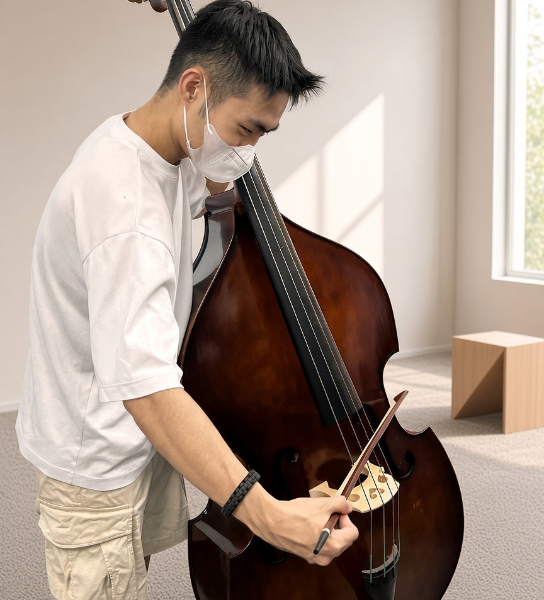
In the picture - Ong Zi Xe
Student (Double Base) since 2014
Why Music Education is IMPORTANT
Sequential Music Instructionis not only hearing and enjoying music, but the ability to read, understand and to play musical instruments had been proven by many research foundations, either independent or government related, to have major benefits to the brain developments of both children and adults. Abreast with this finding, the result still proves to be more effective for children if a child begins formal music education in the early age.
What happens when a young child exposes to music and begins music education? Here are some of the compiled discoveries from both the Auditory Neuroscience Laboratory of Northwestern University, Chicago and the National Center for Biotechnology Information, USA:
Infant Babies tend to be able to distinguish differences in pitch, melody and rhythm from very early on. They even seem to be able to recognize music they were exposed to repeatedly in the mother's womb.
Pre-schoolers As a child ages between 3 to 5 years old, they were able to learn body parts better in a lesson that used music and dance as opposed to conventional lessons, or even one including movement but without music. In addition, we've discovered that those who had music keyboard training did better at math reasoning than another group that had computer training instead.
Primary &
Secondary School
As a child gradually grows into maturity, those who received daily music training for seven
months had higher reading scores. This result proves to be consistent for every year when they
were tested.
College students As young adults, those who had received musical training before age 12
remembered significantly more words from a list than other students.
Adults In the workplace, a general discover suggest that those with formal music education tends to have calmer and better sequence of approach in problem solving than their peers. You may be asking, what makes music contribute to such immense improvement in personal development?
How It Happened?
The answer is quite simple but relates complicatedly with many other subjects of the human body. When a person begins music education, a student will first be taught to read a music notes written in the manuscript score. On every time when a person plays music, he or she would have to identify first, the cleffs; second, key signatures; then the time signatures, tempo, rhythm and later notes and time interval one by one, etc. Amazingly, it will eventually cultivate as a discipline that helps to break down big problems into smaller pieces and handle them one by one.
Nature has made our mouth to be able to pronounce a word one by one when we read. However, when a person begins to read the music score and plays the piano for example, with both hands and all fingers working differently in harmony, it is like telling the brains to process and mouth to speak ten words at the very same time. Thus contributing to immense ability in reading and comprehension in due time.
Furthermore, there are many other factors of music education contributing to the building positive emotions of a person such as calmness, harmony, constructive responses, etc. These benefits mentioned are just a tip of the ice berg and it doesn't happen overnight. Music education requires long term study and discipline, consistency and persistency; it is these attributes that further mold a person to excel in many other areas of life.
Is Music Education Only Beneficial For Children?
Absolutely Not! When adults make the decision to learn a new skill, it is solely because they want to. There is no driving force telling them they have to. They rely on self-motivation as well as the desire to be a part of a community. This is where learning to play an instrument comes in. In addition to being part of a team of other musicians, the benefits of music education for adults includes improved quality of life by relieving stress and improving the brain's cognitive function.
Dr. Roy Ernst is the founder of the New Horizons International Music Association (NHIMA), which supports a number of organizations nationwide. These organizations provide music education for retired adults in group settings. "People make strong connections to life through music... most importantly, group music makes connections to other people. They are part of a team working towards goals," says Ernst. He points out that the people who participate make new friends who share a common interest, and that socialization is an important aspect of good physical and mental health.
Stress plays a big part on both physical and mental health. When it comes to making music, the intention is to engage in a recreational activity that makes you feel comfortable and relaxed, thus reducing the stress factor. In addition, learning notes and rhythm requires an individual's full attention., which improves concentration and cognitive skills. Dr Ernst states "Think of reading notes at perhaps four notes per second, with each note having many qualities such as pitch, duration, articulation, dynamics and context. Then, that all needs to be processed into motor skills. After all that, it still needs to become an artistic expression." That being said, it is stated on numerous pages of NHIMA's website that absolutely everyone has the ability to learn music, and that everyone has musical talent in them.
Speak To Us.
If you would like to find out more about the class schedules and lesson structure, don't hesitate to drop us a message.